
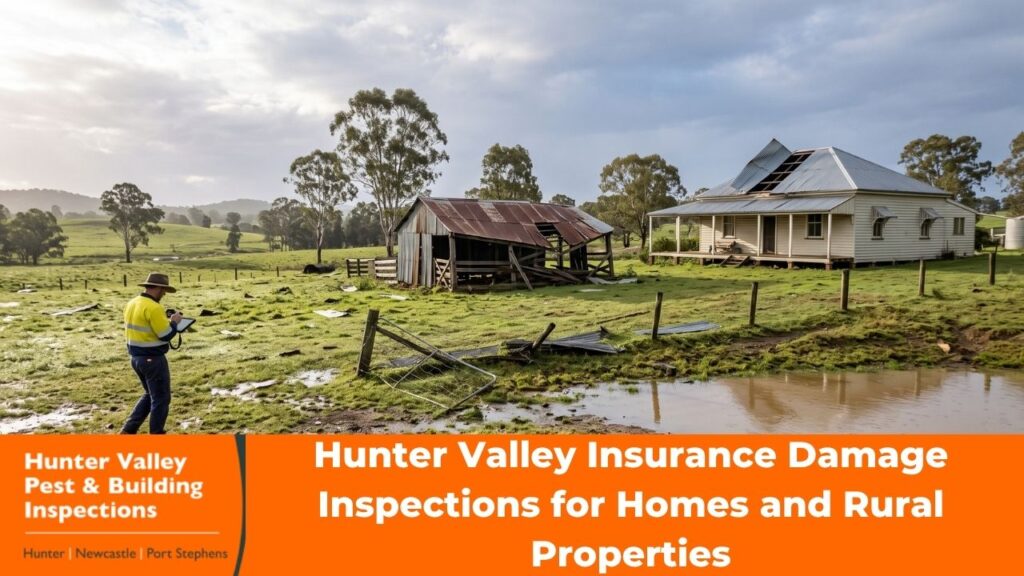
After a storm, fire or flood, the house is the part everyone looks at first. On a Hunter Valley property it is rarely the part that decides the claim.
A damage inspection needs to cover every structure on the site, and the policy behind it treats those structures differently depending on what they are used for. The gap between what was damaged and what the policy calls a home building is where rural claims come apart.
What is an insurance damage inspection?
An insurance damage inspection is an independent assessment of what was damaged, what caused it, and when, written up as a report for a claim. It is not a quote and not a repair plan. Its job is to establish cause and extent in a form an insurer or an ombudsman can assess.
That makes it a different document from the building defect inspection or the dilapidation report on this site, both of which answer different questions. The report here is built around an event and a date.
Why are rural claims harder than suburban ones?
Four reasons, and they compound. A rural site has more structures than a suburban one. Those structures are used for different purposes, which changes how the policy treats them. Damage is often found late, because nobody walks the back paddock daily. And the cause is harder to pin down across a site measured in hectares.
A single storm can leave a lifted roof sheet on the house, a collapsed hay shed, a fence down across two boundaries, a flooded pump shed and silt through a machinery bay. That is one event and five separate assessments, each needing its own cause, its own extent and its own place in the policy.
What counts as a home building?
This is the part that catches rural owners. The Insurance Contracts Regulations 2017 define a home building for the purposes of standard cover, and the definition turns on what a structure is used for rather than what it looks like.
A home building means a building used principally and primarily as a place of residence, together with out-buildings, fixtures and structural improvements used for domestic purposes related to that residence.
| Expressly included | Expressly excluded |
|---|---|
| Fences and gates wholly or partly on the site | A temporary building or structure, or a demountable or moveable structure |
| Services, underground or not, that the insured owns or must repair | A building in the course of construction |
| Fixed wall, ceiling and floor coverings other than carpets | A caravan, whether fixed to the site or not |
| Out-buildings used for domestic purposes related to the residence | A building let or rented out as a business that is not the principal residence |
Read the included column first, because fences surprise people. Fences and gates on the site sit inside the definition, which is worth knowing before anyone writes off a boundary run as uninsurable.
Then read the excluded column. Demountable and moveable structures are out, and on acreage that reaches a long way: relocatable sheds, shipping containers used for storage, portable site offices, transportable cabins. A shed delivered on a truck and bolted down may not be treated the same way as one built in place.
The harder line is the domestic purposes test. A garage holding the family car is an out-building related to the residence. A machinery shed, a hay shed, stock yards, a shearing shed or a pump house serving a farming operation are not used for domestic purposes, so they sit outside the home building definition and outside the statutory minimum that goes with it.
That does not mean they are uninsured. It means they are insured under whatever a farm or rural policy says, with no legislated floor underneath it. The policy wording becomes the whole of the answer, and the report must be written to that wording rather than to a residential assumption.
The dam in the flood definition
Flood has a standard meaning fixed by regulation. Under the same Regulations, flood means the covering of normally dry land by water that has escaped or been released from the normal confines of a lake, a river, a creek, another natural watercourse, a reservoir, a canal or a dam.
A farm dam is on that list. Water over the wall of a dam, or released from it, is flood rather than storm, and the two are often covered differently. Under the Insurance Contracts Act 1984, that standard meaning applies in a prescribed contract even where the policy defines the word differently.
For a Hunter Valley property that matters twice over. Rainfall that runs off a hillside and pools against a shed is not flood under that definition. Water that comes over a dam wall is. The same weather event can produce both on the same property, 200 metres apart, and the report needs to say which is which.
What the report has to establish, structure by structure
One report, several assessments. For each damaged structure the report should record what it is, what it is used for, what failed, what caused the failure, and the extent of the damage, with the date and the conditions on the day.
Use of the structure is the line most reports leave out, and on a rural site it is the line that decides which part of the policy applies. Thermal imaging matters where water has tracked into a wall or a ceiling cavity and the extent is not visible, and a mould inspection becomes relevant where a building has stayed wet for weeks rather than days, which on an outlying structure is common.
For fire events specifically, there is more on what heat and smoke do beyond the burn line in our post on fire, smoke and heat damage. And the general differences between inspecting acreage and inspecting a suburban block are set out in the acreage inspection guide.
When should you book?
Before anything is cleaned up, moved or repaired, and before a temporary fix goes on. Once a roof is tarped, a shed is pushed over and a paddock is cleared, the sequence that explains the cause has gone, and what is left is opinion about photographs.
Lodge the claim promptly as well. An independent report sits alongside the insurer’s own assessment rather than replacing it, and it is far more useful supplied early than produced months later as an argument.
Booking an inspection
Hunter Valley Pest and Building Inspections covers the Hunter Valley, the Upper Hunter, Maitland, Port Stephens, Newcastle, Lake Macquarie and the Central Coast, including properties well off the main roads. Call 0488 885 203 or Order an Inspection online
When you book, say what happened, when it happened, and how many structures are affected, so the right amount of time is allowed on site.
This article is general information about how home building cover is structured in Australia. It is not financial or legal advice, it does not take your circumstances into account, and it is not a statement about what any policy covers. Read your own product disclosure statement and speak to your insurer or a qualified adviser about your claim.
Frequently Asked Questions
Are farm sheds covered under home building insurance?
Not under the standard cover definition. A home building includes out-buildings used for domestic purposes related to the residence. A shed serving a farming operation falls outside that, so it depends entirely on what a farm or rural policy says. Check the wording before assuming either way.
Is water from a dam treated as flood?
Yes, under the standard definition. Flood covers water escaping or released from the normal confines of a lake, river, creek, natural watercourse, reservoir, canal or dam. That meaning applies in a prescribed contract even if the policy words it differently.
Are fences covered?
Fences and gates wholly or partly on the site are inside the home building definition for standard cover purposes. Individual policies often apply sub-limits, so the question is usually how much rather than whether. Your product disclosure statement will set that out.
Can one report cover the house and the outbuildings?
Yes, and it should. What it must not do is treat them as one assessment. Each structure needs its own use, cause and extent recorded, because the policy may handle them under different sections with different limits.