
Most landlords are doing the right thing. They respond to maintenance requests, they use a property manager, they get the place re-painted between tenancies. What fewer landlords have thought carefully about is a more specific question: if something went wrong on their property and a tenant or visitor was injured, could they demonstrate that reasonable steps had been taken to identify and manage risks?
That question matters more than most people realise.
What the Law Expects of Residential Landlords
In NSW, residential landlords have obligations under the Residential Tenancies Act 2010 to provide and maintain a rental property in a reasonable state of repair, having regard to its age, character, and prospective life. The property must also be fit for habitation at the commencement of a tenancy and throughout it.
Beyond the tenancy legislation, common law duty of care applies. If a tenant, a member of their household, or a visitor to the property suffers injury or loss as a result of a defect in the property, a landlord may be liable in negligence if it can be shown that the risk was foreseeable and that reasonable steps were not taken to address it.
“Reasonable steps” is the key phrase. It doesn’t mean perfection. It means what a reasonable property owner, knowing what they knew or should have known, would have done to identify and manage risks.
The Problem with Property Manager Inspections
Property manager routine inspections are a normal part of managing a tenancy. They check that the tenant is maintaining the property to a reasonable standard, note obvious maintenance issues, and provide a record that the property is being managed.
They are not professional building inspections.
A property manager checking through a rental property isn’t trained to identify structural defects, concealed water damage, or pest activity. They don’t go into the roof space. They don’t get under the floor. They don’t carry a moisture meter to check whether the shower waterproofing is failing behind the tiles.
This distinction becomes critical if something goes wrong. A folder full of property manager inspection reports demonstrates that the tenancy was being managed. It doesn’t demonstrate that the building’s condition was professionally assessed.
In older Hunter Valley properties across Cessnock, Kurri Kurri, Weston, and Maitland, concealed defects are common. Subfloor timber decay from years of moisture exposure. Roof structures with past or active termite damage. Waterproofing failures in wet areas that have been tiled over. None of these show up in a routine property manager check.
What “Reasonable Steps” Looks Like in Practice
A professional building maintenance inspection by a licensed and independent inspector creates a record that is categorically different from a property manager report.
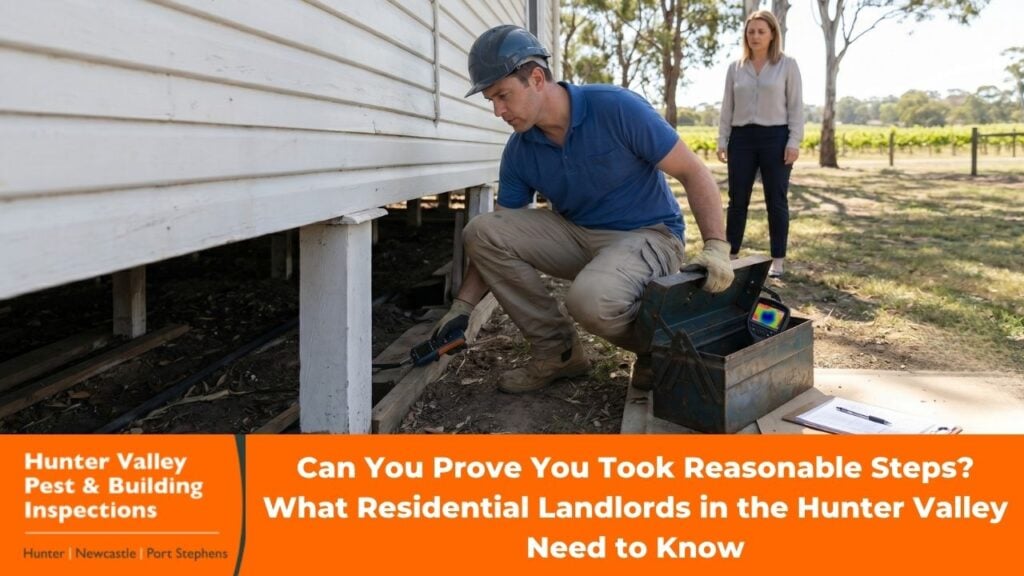
Our inspectors are licensed builders with construction backgrounds. Every inspection uses advanced thermal imaging cameras and moisture detectors as standard. These pick up moisture and heat patterns in wall cavities, wet areas, and roof spaces that are invisible to the naked eye. We physically enter the roof space and subfloor on every inspection.
The report documents every defect found. Each one is photographed, clearly described, and separated into items needing prompt attention and items to keep an eye on. It’s written in plain English so you actually understand what you’re looking at.
That report, filed and acted on, is what “reasonable steps” looks like in documentation form.
The Older Housing Stock Question
Hunter Valley landlords with older properties, like weatherboard homes, older brick veneer, or properties with original subfloor construction, need to be thinking about this more carefully than landlords with newer builds.
These properties have age-related vulnerabilities. Original timber framing and subfloor stumps that have had decades of exposure to Hunter Valley conditions. Galvanised plumbing approaching or past its service life. Roofing that may have been repaired rather than properly maintained over the years.
None of this makes them bad investments. It does mean the building’s condition needs to be actively monitored rather than assumed.
A professional building inspection every two to three years, paired with annual timber pest inspections given the termite pressure across the Hunter region, creates a documented maintenance record that demonstrates ongoing, active management of the property’s condition.
Before the Next Tenancy
The period between tenancies is the most practical time to get a professional building inspection done. The property is vacant, every room and space is fully accessible, and any defects found can be addressed before a new tenant moves in.
It’s also the point at which the condition of the property can be clearly documented at the start of the tenancy. That baseline protects landlords in a tenancy dispute just as much as it does in a liability situation.
If you own rental property in the Hunter Valley and can’t point to a professional building inspection in the last two to three years, that’s worth addressing.
Call 0488 885 203 or Order an Inspection online today. We service Cessnock, Maitland, Singleton, Kurri Kurri, Branxton, Pokolbin, and all surrounding areas across the Hunter Valley.