You’ve found a property you like. You’ve walked through it twice. You checked the taps, looked at the ceiling, peered under the sink. It all seemed fine.
Here’s the problem: the things that cost buyers the most money are almost never visible during a standard walkthrough. They’re in the roof space. They’re under the floor. They’re behind the walls. And in the Hunter Valley, where older housing stock is common and termite pressure is year-round, what you can’t see is often exactly what you need to know about.
What You Can See vs. What Actually Matters
A home is showing well for an open inspection. Lights are on, the place is clean, windows are freshly wiped. What you’re seeing is the presentation layer.
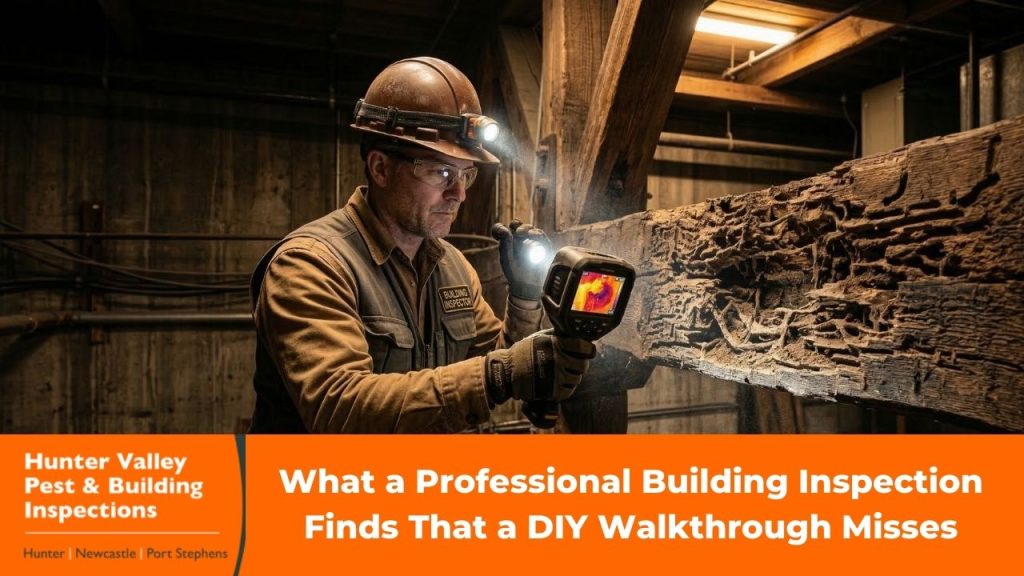
A licensed building inspector doesn’t look at the presentation layer. They crawl into the roof space and spend time up there. They get under the floor if there’s a subfloor – lying on their back in tight spaces, checking timber framing, looking for termite workings, moisture damage, inadequate piers. They check every window for failed sash cords and water damage in the frames. They test moisture readings in every bathroom and wet area. They look at the drainage around the property and consider where water goes when it rains.
A thorough inspection on an average house takes 2-3 hours on site. That’s not excessive – that’s what it takes to assess a property properly.
The Specific Things That Get Missed
Termite damage in the subfloor and roof void
This is the big one. Active termites and past termite damage are found regularly in properties across the Hunter Valley, Maitland, Cessnock, Branxton, and Singleton areas. Not in obviously neglected properties – in well-presented homes that were recently painted and listed for sale.
Termites work from the inside out. By the time you can see evidence at the surface, the framing behind it may already be seriously compromised. A visual inspection of rooms tells you nothing about what’s happening inside the wall studs or the floor framing underneath.
Our inspectors physically enter the subfloor and roof void on every inspection. We’ve found active termites in the subfloor of properties where the vendor-supplied report showed nothing – and where the house looked perfectly fine from the inside.
Moisture and leaking showers
Leaking showers are one of the most common defects found in pre-purchase inspections, and one of the easiest to miss with a casual look. The shower looks fine. The tiles are intact. There’s no visible water staining on the floor.
What’s happening is that water is tracking through failed waterproofing behind the tiles, into the wall framing or subfloor below. By the time you see the problem – a soft patch in the floor, peeling paint on an adjoining wall, a damp smell – the timber damage underneath has been developing for months or years.
We use a Tramex moisture meter as standard on every inspection. It picks up moisture behind surfaces without needing to open anything up. High readings in a shower area or wet room tell us exactly where to focus attention, long before there’s any visible sign.
Defects invisible to the naked eye
Thermal imaging detects heat signatures and moisture patterns that no walkthrough will find. Active termite workings show up as heat spots. Water leaking from a roof or plumbing shows up as moisture behind wall cavities and ceilings – sometimes well away from the actual source of the leak.
We use the Bollard T4 thermal imaging camera on every inspection as standard. Not as an optional add-on. Thermal imaging has changed what we find on inspections – roof leaks that had no visible ceiling staining yet, plumbing leaks behind tiled walls, termites in locations that would never have been checked otherwise.
Structural and framing issues
Cracking in brickwork is easy to spot. What’s harder for a buyer to assess is whether that cracking is cosmetic or structural – whether it’s the result of normal thermal movement or an indicator of foundation movement that will keep progressing.
Framing issues in the roof space are invisible from inside the house. We’ve found roof framing timbers significantly compromised by past termite damage, sections of frame that were never properly fixed to the structure, and temporary props left in place by builders that were never replaced with proper supports.
None of that is visible to a buyer walking through the house. An inspector who physically enters the roof space and knows what they’re looking at will find it.
Drainage and water management
Poor site drainage is one of the most consistent contributors to ongoing building problems in the Hunter Valley. Properties with ground that slopes toward the house, or with inadequate drainage around the perimeter, can have moisture sitting against foundations and subfloor areas for extended periods after rain.
This creates ideal conditions for termites and timber decay. It’s also a problem that gets significantly worse over time if not addressed.
During an inspection we look at how water moves around and away from the property. We check stormwater outlets, assess ground levels, and look for evidence of water pooling or tracking toward the structure. None of this is visible from inside the house.
Why Agent-Supplied Reports Aren’t Enough
Some vendors provide a pest and building report as part of the sale. The intention is to save buyers the cost of their own inspection.
The problem is straightforward: the vendor commissioned and paid for that report. The inspector’s client was the seller, not you. And the vendor has a clear interest in the sale proceeding.
Independent buyers’ inspections find things that vendor reports miss. We’ve seen it repeatedly – our inspectors have found active termites and major structural defects in properties where the vendor report identified nothing of significance. When you’re making one of the largest financial decisions of your life, you need a report that was written for you, by someone working for you.
What a Good Report Looks Like
Our reports are detailed including, colour photographs of every defect found. Written in plain English, divided clearly between minor maintenance items and major defects that need prompt attention.
After you receive the report, you’re welcome to call your inspector directly to walk through the findings. Not a call centre – the person who did the inspection.
The aim is that you finish the process understanding exactly what you’re buying. What needs attention now, what can wait, and what the real risks are. That’s the information you need to decide whether to proceed, negotiate, or walk away.
Buying in the Hunter Valley
The Hunter region has specific conditions that make thorough inspections particularly important. Termite pressure across the region is high – from coastal areas through to the vineyards and rural properties around Pokolbin, Branxton, and Singleton. Older housing stock in Cessnock, Maitland, Kurri Kurri, and Weston means more properties with original timber framing, galvanised plumbing, and construction methods that predate current pest management standards.
Acreage properties add additional complexity – more buildings, more structures, more subfloor area, more perimeter to assess. We inspect acreage properties across the Hunter regularly and know what to look for in rural settings.
If you’re buying in the Hunter Valley and you want an inspection done properly, call us on 0488 885 203 or Order an Inspection online.