
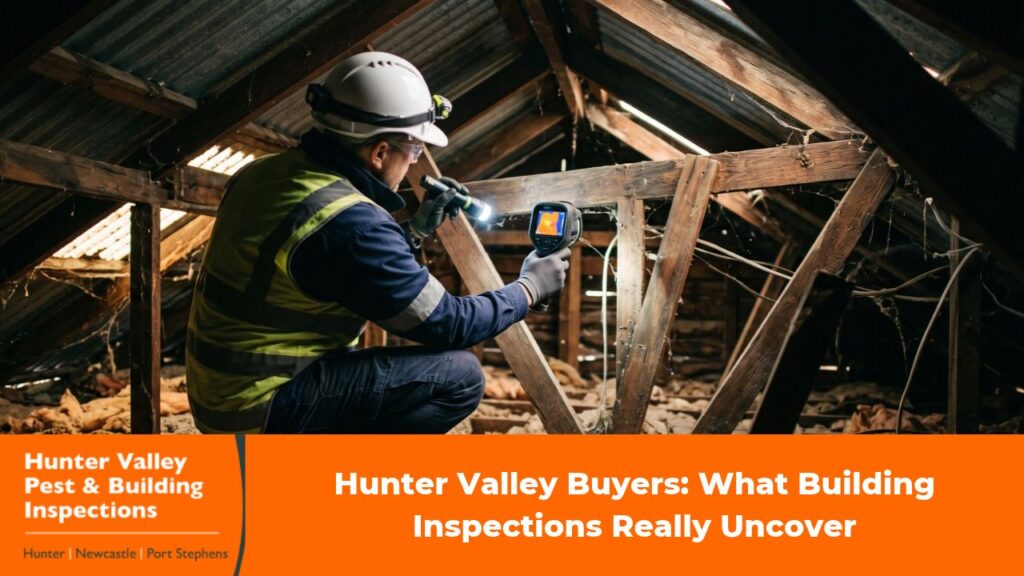
Termites and a leaking shower. That’s what most Hunter Valley buyers expect a building inspection to turn up, and plenty of inspections find exactly that.
The findings that change a purchase are usually the ones nobody went looking for. A patio nobody ever got approved. Cracking that isn’t ordinary settlement. Roof framing cut through for a bathroom extension in 1987 and never made good. And in this part of the state there’s one more that catches buyers out regularly, and it has nothing to do with pests.
Unapproved Structures, and Why They Matter More Here
Most of the Hunter sits inside a declared Mine Subsidence District. Cessnock, Kurri Kurri, Maitland, Singleton, Newcastle, Beresfield, Muswellbrook, Aberdeen and Dungog all have districts, declared by Subsidence Advisory NSW in areas where old or active underground coal mining creates a subsidence risk.
Two things follow from that, and the second one is the one people miss.
First, if you build or subdivide inside a district you need Subsidence Advisory approval before work starts, on top of anything council requires.
Second, every home and building in NSW is eligible for compensation if mine subsidence damages it, inside a district or outside one, provided the correct development approvals were obtained. That last clause is doing a lot of work. A patio, carport, deck, granny flat or rear extension that went up without approvals does not stay a tidy council paperwork problem. In a subsidence district it can sit outside the compensation framework entirely.
An inspector doesn’t run title searches or pull DA records. That’s your conveyancer’s job. What an inspector does is spot the structure that looks like nobody signed anything for it. The patio roof bolted straight to the fascia. The carport enclosed into a room with no wall bracing. The extension with a different roof pitch, a different brick and no articulation joint where old meets new. Those are the flags that send your solicitor looking before you exchange, rather than three years later when a crack opens up.
Subsidence Advisory’s own advice to buyers in a district is to have your solicitor or conveyancer confirm three things with the seller: that structures were built with the correct approvals, that no unauthorised work has taken place, and if any subsidence claim is pending or has been paid out on the property before. You can check whether a property is in a district yourself in a couple of minutes.
Cracking, and Whether It Means Anything
Every buyer in the Hunter looks at a crack and wonders. Most cracking in a brick veneer home is cosmetic and always was. Some of it isn’t.
What an inspector reads is the pattern rather than the crack itself. A crack that steps through the mortar joints reads differently to one running straight through the bricks. Width matters, and so does the way the width changes along its length. Does it repeat on the opposite wall? Have the doors and windows gone out of square? Is the floor out of level in the same corner, and is there an articulation joint anywhere near it?
Ground movement is a live category here in a way it isn’t everywhere. Reactive clays through the Maitland and Thornton flats behave differently to the ridges around Cessnock and Kurri Kurri, and the region has had a fair bit of seismic attention in recent years. We’ve written separately about building inspections after an earthquake.
One honest limit here. An inspection flags structural cracking and tells you it needs further investigation. Diagnosing the cause and specifying the fix is a structural engineer’s work. Any inspector who hands you a repair method for serious structural cracking is going past what a building report is for.
The Roof Space and the Subfloor
The two places nobody looks at an open home are the two places where most of the real findings sit.
- Roof members cut, notched or removed to fit a bathroom or a rangehood, with nothing put back.
- Missing or unfixed roof bracing, and sarking that stops short of the gutter line.
- Ant capping rusted through or bridged by a later concrete path or garden bed.
- Temporary formwork left in place under a slab or verandah, which is a straight invitation to termites.
- Site drainage running under the dwelling instead of away from it, which is behind a surprising share of damp and pest problems in older Hunter homes.
That is also why thermal imaging and a moisture meter get used on every inspection rather than sold as an upgrade. A stained ceiling tells you there was water. A moisture reading tells you whether it is still wet. Our post on what a professional inspection finds that a walkthrough misses goes through the general version of this in more detail.
The Coalfields Housing Stock
The old mining towns have a building stock all of their own. Weatherboard and fibro cottages through Kurri Kurri, Weston, Abermain and Cessnock, plenty of them a century old, sitting on timber or brick piers with a decent subfloor underneath.
They are often better built than they look. What they reliably need is a close read of things that were normal practice at the time and are not now. Piers dry stacked without mortar, or packed up with timber wedges that have since dropped. No damp course, or a damp course bridged by a garden bed added decades later. Verandah posts off their stirrups. Original wiring that has been extended rather than replaced. Rooms that were clearly a back verandah before somebody enclosed them.
None of that means walk away. It means knowing the list before you set the price, because these are the houses where a report earns its money in the negotiation rather than in the walk-away.
Old Termite Damage Beats Live Termites
A live infestation is unpleasant to hear about, but it is a known quantity. It gets treated, the cost is quotable, and it becomes a price negotiation.
Previous damage is the harder finding. Timber that was eaten out years ago, treated properly, and then never repaired, because the treatment stopped the colony and nobody wanted to open the wall. The termites are long gone and the structural capacity never came back. A timber pest inspection records both, and the second one is what deserves your attention, because a treatment certificate in the vendor’s paperwork says nothing about whether the framing was made good afterwards.
What an Inspection Won’t Uncover
Worth being straight about, because a report that promises everything is not doing you a favour.
It’s a visual inspection. Nobody lifts roof tiles, opens up walls, digs up drainage or moves the vendor’s stored goods out of the garage. Anything a stack of boxes is sitting on top of gets recorded as an area that couldn’t be inspected, which is itself useful information.
It also doesn’t search titles, approvals or development consents, doesn’t survey boundaries, doesn’t certify pool compliance, and doesn’t replace a structural engineer where one is called for. Those sit with your conveyancer or with a separate specialist, and a good report will tell you when to go and get one.
Booking an Inspection in the Hunter Valley
Hunter Valley Pest and Building Inspections is based in Kurri Kurri. Every inspector is a licensed builder with a minimum of 20 years in the trade, and the business carries both public liability and professional indemnity cover, which is worth checking with anyone you engage since the industry was deregulated. Thermal imaging and a Tramex moisture meter are used on every pre-purchase pest and building inspection at no extra charge, and reports come back within 24 hours, emailed to you and to your solicitor or conveyancer.
We inspect across Maitland, Cessnock, Kurri Kurri, Singleton, Branxton, Lochinvar, Rutherford, Aberglasslyn, Thornton, Chisholm, Cliftleigh, Heddon Greta, Weston, Bolwarra and the surrounding Hunter, and we travel to Newcastle, Port Stephens and the Central Coast.
Call 0488 885 203 or order an inspection online.