
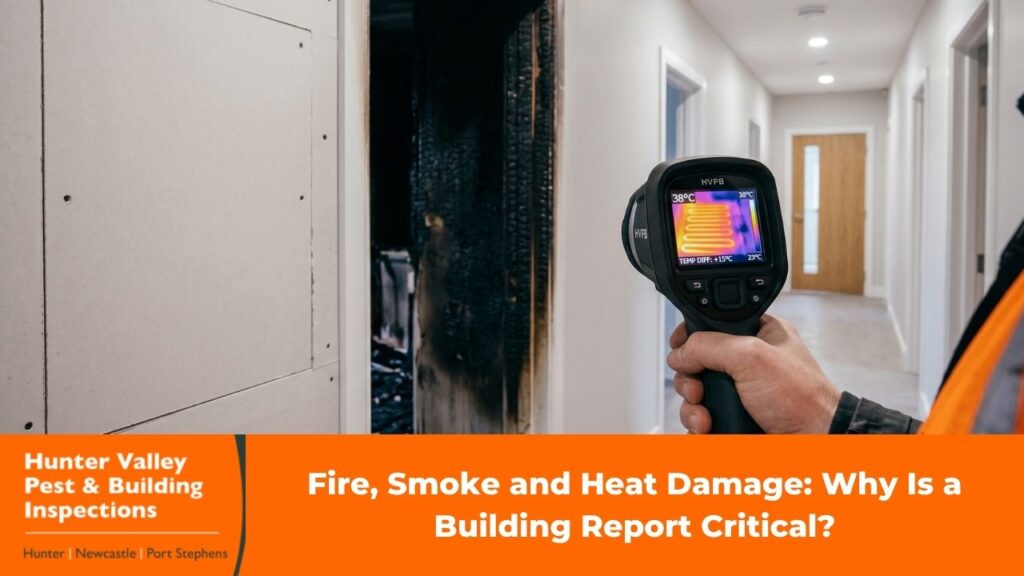
A fire in or near a building, even one that seems minor or quickly contained, does damage that isn’t always obvious straight away.
Visible char and burn marks are the easy part. What’s harder to assess without proper inspection is what happened to the structural elements you can’t see, what the heat did to materials that weren’t directly in the fire, and how far smoke and soot have travelled through the building’s cavities. Getting that wrong (either underestimating the damage or not understanding what needs to be addressed before repair work starts) creates serious problems down the track.
This is why a professional building inspection report matters after any fire or significant heat event. Not as a formality. Because the information it gives you is genuinely different from what you can assess yourself.
What Fire Does to a Building Beyond the Obvious
Most people focus on what has burned. The cupboard. The wall. The section of roof. That’s understandable, it’s what you can see.
But heat affects materials well beyond the point of combustion. Timber framing exposed to sustained heat without catching fire can experience significant structural change. The moisture content drops rapidly, the fibres compress and weaken, and load-bearing capacity can be compromised in framing that looks externally intact. You can’t identify this with a visual check. It requires an inspector who understands timber behaviour under thermal stress and knows what to look and test for.
Masonry and brick react differently again. Mortar joints can crack and lose integrity at temperatures lower than those that visibly damage the bricks themselves. Structural cracking in brickwork that appears minor on the surface can indicate deeper movement or failure in the mortar bed. In older homes around Cessnock, Kurri Kurri, and Maitland, where brick construction from the 1950s and 60s is common, this is a real concern after any fire event close to or within the building.
Roof structures take the brunt of the fire, as well all know heat rises. Even a contained fire in a lower level of a house pushes significant heat into the roof space, potentially affecting rafters, purlins, and collar ties that weren’t directly exposed to flame.
Smoke Travels Further Than You’d Think
Smoke and soot don’t stay in the room where the fire was.
They move through every gap they can find: into wall cavities, ceiling spaces, subfloor areas, and through penetrations in the building fabric. In a standard timber-framed house, there are enough gaps around pipes, cables, and structural connections to carry smoke throughout the building fairly efficiently.
This matters for two reasons. First, soot residue left in concealed cavities continues to cause problems: corrosion of metal fixings and electrical components, ongoing odour, and in some cases health impacts from residue that outgasses over time. Second, the presence of smoke and soot in cavities tells an inspector a great deal about how the fire moved through the building and which areas need closer examination.
Thermal imaging is particularly useful here. Heat that has transferred into wall cavities and ceiling spaces shows up clearly on the Bollard T4 camera we use on every inspection. So does residual moisture from firefighting efforts. Water used to suppress a fire ends up in places that are difficult or impossible to see without the right equipment. Left undetected, that moisture creates the same long-term problems as any other water ingress: timber decay, mould, and termite attraction.
The Structural Assessment That Can’t Wait
If you’re dealing with fire damage on a property, whether it’s your own home, an investment property, or something you’re looking to purchase at a reduced price after a fire event, the structural assessment needs to happen before any repair or remediation work begins.
This is a point that catches people out. The instinct after fire damage is to start cleaning up and repairing. But repair work that covers or removes structural elements before they’ve been properly assessed and documented removes the evidence you need: for insurance purposes, for understanding what the building needs, and for ensuring the repairs are addressing the real damage rather than just the visible surface damage.
A licensed building inspector with construction experience, not just an inspection qualification, can assess whether structural elements are genuinely compromised or whether the damage is surface-level. That distinction directly affects what repairs are needed and what they’ll cost. We’ve seen repair scopes that were either significantly over-specified because the damage wasn’t properly understood, or, more dangerously, under-specified because concealed damage wasn’t found before work started.
Buying a Property with Fire Damage History
Properties that have had fire damage are sometimes sold at a discount. That discount is only meaningful if you really know what you’re buying.
Cosmetic repairs after a fire can look convincing. Fresh paint, new plaster, replaced cabinetry. What you can’t see from a standard inspection is whether the structural framing behind those new walls was assessed and repaired or just covered up. Whether the roof space was checked and treated. Whether smoke-damaged insulation was replaced or left in place.
A thorough pre-purchase building inspection on a property with known fire damage history, using thermal imaging, moisture metering, and an inspector who physically accesses the roof space and subfloor, will find what’s there to be found. The alternative is discovering it after settlement, when the problem is yours to deal with.
If the selling agent can’t provide documentation of the scope of repairs following a fire event, that’s information too.
Insurance Claims and Documentation
For properties currently going through an insurance claim, a building inspection report from an independent licensed inspector creates a record that belongs to you.
The insurer will send their own assessor. That person works for the insurer. Getting your own independent report, ideally completed promptly after the fire event before any clean-up or repair work, gives you documentation of the property’s condition that you control. It can support negotiations around the scope of repair, identify damage the insurer’s assessor may not have found, and provide a clear baseline if disputes arise about what the event caused.
The Hunter Valley Region
The Hunter region has a genuine fire risk landscape. Properties in and around Cessnock, Singleton, Branxton, Pokolbin, and the upper Hunter border bushland that has seen significant fire events in recent years. Rural and semi-rural properties with timber construction, older homes on acreage, and buildings with accumulated vegetation around the structure are all in a higher-risk category.
A post-fire building inspection in this context isn’t just about documenting what burned. It’s about understanding what the event did to the structure, what the consequential risks are, and what needs to happen before the building is safe and sound again.
Call our team on0488 885 203or Order an Inspection online.